How much sales tax do you pay in a year? Ask your receipts
· 4 min read
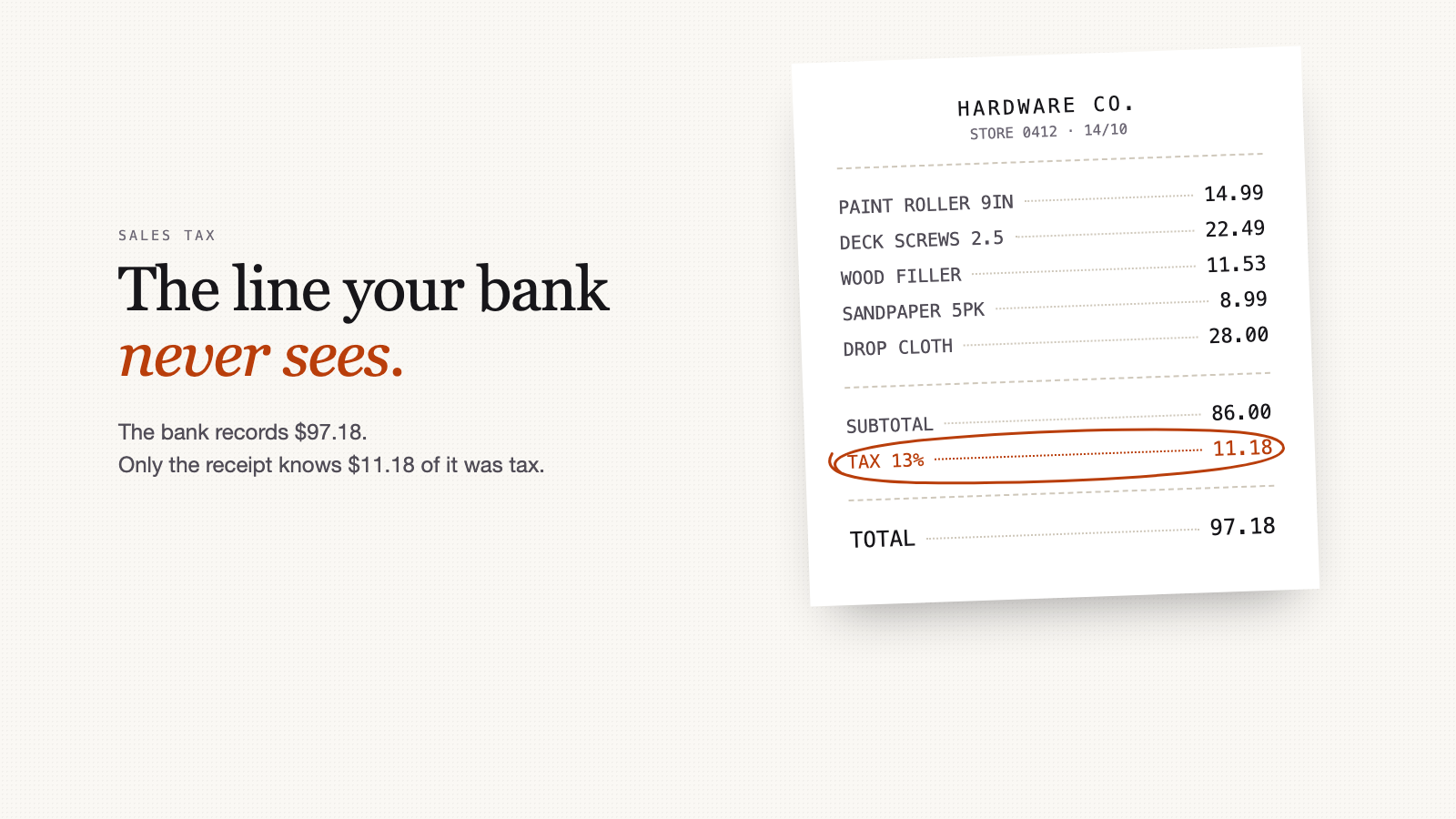
Almost every receipt you get has a tax line on it, and almost nobody adds them up. Over a year it can come to hundreds of dollars, and your bank statement can't tell you the figure, because the bank only ever sees the total.
Why the bank can't tell you
When you pay $73.50 at a hardware store, your bank records $73.50. It doesn't know that $65.04 was the price and $8.46 was tax, or that some of what you bought was taxed and some wasn't. That split exists in exactly one place: the receipt.
So if you want to know how much tax you pay on everyday spending, the receipts are the only source. Bank exports, card statements and apps built on them can't answer the question.
A month, worked through
Here's an example month of receipts. The tax rate is an example too: 13%, applied to whatever was taxable. Where you live, the rate and the rules will differ.
| Receipt | Subtotal | Tax |
|---|---|---|
| Grocery run | $142.30 | $3.12 |
| Pharmacy | $38.00 | $4.94 |
| Hardware store | $86.00 | $11.18 |
| Restaurant | $64.00 | $8.32 |
| Online order | $119.99 | $15.60 |
| Total | $450.29 | $43.16 |
Three things show up straight away.
The tax you pay is less than the headline rate. $43.16 of tax on $450.29 of purchases is about 9.6%, not 13%. Out of the $493.45 you actually paid, tax was about 8.7%.
The gap is mostly groceries. The grocery receipt's tax is $3.12 on $142.30, about 2.2%. In this example, only $24 of that shop was taxable: the bin bags, the dish soap and a bag of chips. The rest was basic food, which in many places is taxed less or not at all. In others, it's taxed in full. This varies more than almost any other tax rule, so check yours.
The yearly number is real money. If this month is typical, $43.16 × 12 = $517.92 a year in sales tax. Your spending isn't typical every month, so treat that as a rough figure, but it's the right order of magnitude to plan with.
What you can do with the number
Budget with the tax-in price
The most practical use. A $1,200 laptop at 13% costs $1,356. At 5%, it costs $1,260. If you save up for the sticker price, you'll be short at the till. For anything big, budget for the price after tax.
Check receipts for mistakes
Once you look at tax lines, odd ones stand out: tax on an item that's normally exempt where you live, or tax charged twice on a line. Mistakes are uncommon, but they happen, and a quick look at the tax line on a large receipt is the only way to catch one.
Keep it for tax time, if it applies to you
This is where it depends heavily on where you live and your situation, so take it as a pointer, not advice:
- In the US, people who itemize deductions can generally choose to deduct state and local sales tax instead of state income tax. The IRS publishes tables that estimate it, but actual receipts can show a higher figure. Whether it's worth it depends on your state and your other deductions.
- If you're self-employed or run a small business, the sales tax on business purchases may be recoverable if you're registered to collect it. In Canada, for example, that's done through input tax credits on GST/HST.
- For everyone else, the yearly figure is mostly useful for understanding where money goes, not for getting any of it back.
If any of this might apply to you, an accountant or tax preparer can tell you in ten minutes whether your receipts are worth keeping for it. Ask before tax season, not during it.
Doing it without a spreadsheet
Adding up tax lines by hand is tedious, but it's the kind of tedious you only need once to learn the answer.
The low-effort version: keep every receipt for one month in an envelope. At the end of the month, add up the subtotals and the tax lines separately. Divide the tax by the subtotal. That's your effective rate, and multiplying the month's tax by 12 gives a rough year.
If your receipts already go into Xpento, the tax line is read off each receipt and kept as its own figure on the expense, separate from the total. Where a receipt shows more than one tax, such as GST and PST, they're added together. That means the split the bank never sees is already recorded for every receipt you've captured.
Do this today
Find the largest receipt you've kept this month. Look at the tax line, then divide it by the subtotal. If the result is well under your local rate, part of that shop wasn't taxed. If it's at or over the rate, check whether everything on it should have been taxed. That's one receipt and two minutes, and it's usually enough to make you curious about the rest.